
A Small Scheduled Grief
The question asked what Sunday evening dread actually feels like, and what it is really about. Twenty Signals arrived. The most striking thing about them is that when the room described the feeling, it described Monday. When the room described what the feeling was really about, it described time itself, and who owns it, and what version of a person is being reclaimed by which shape.
Three sentences from the room name what is happening more directly than any framing could.
"Sunday evening is the funeral." "Sunday evening dread is grief for the version of my life I was going to have." "It is my whole nervous system remembering I do not own my time."
Everything else in the room is a specification of one of those three sentences.
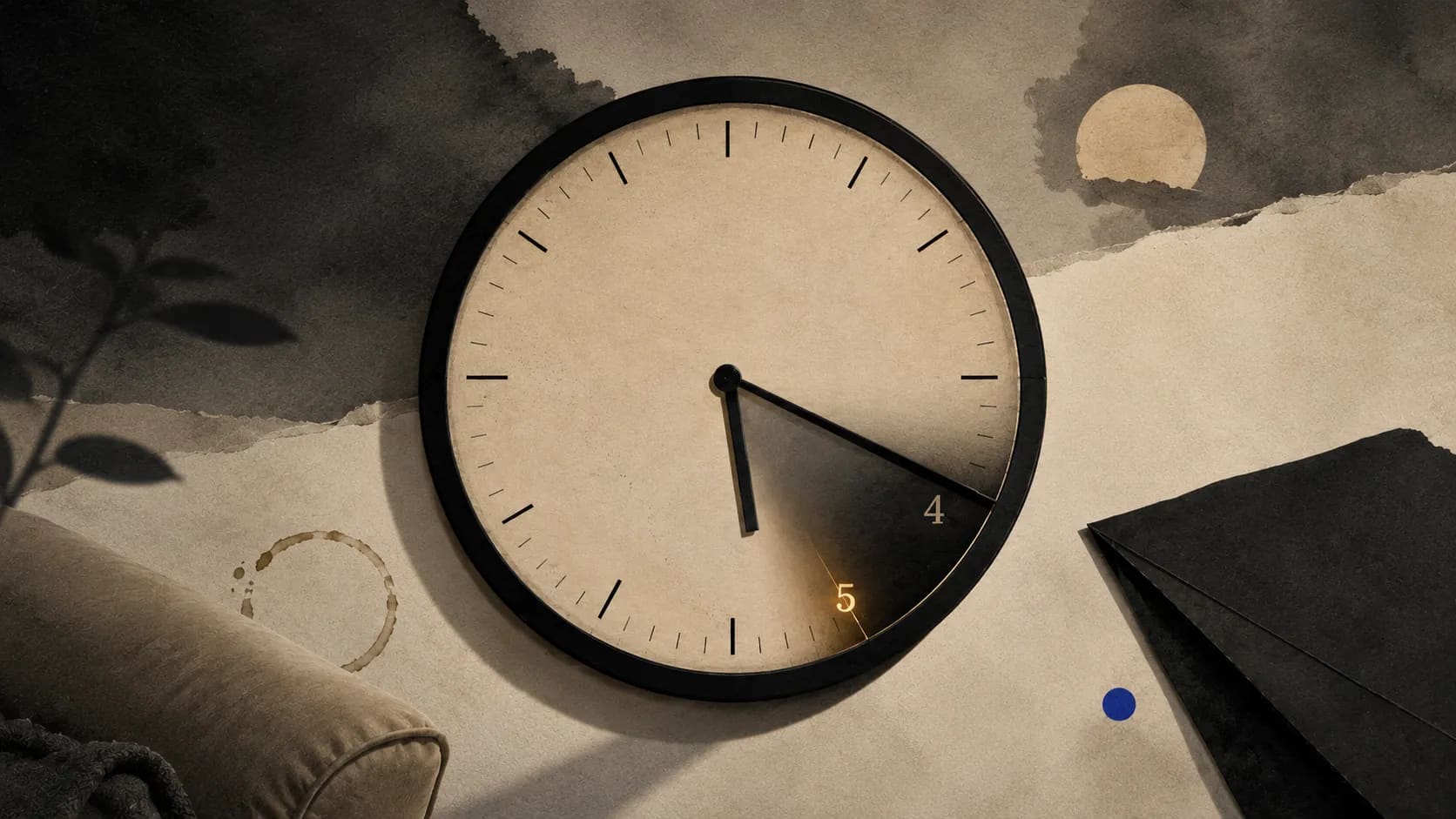
The physical descriptions are precise and consistent. The chest tightens at 6pm. The silence in the kitchen at 8pm arrives with the dishes done and tomorrow's clothes half-laid-out. The light dims to 60%. The unopened emails from Friday whose exact count the participant refuses to check but can feel in the body. The room is very good at locating where the fear lives, and it lives in the small liminal moments of Sunday evening — 4pm, 6pm, 7pm meal, 8pm kitchen, bedtime routine. It is not a diffuse mood. It is a scheduled physical event.
Three shapes are doing most of the interpretation.
The first is loss of a self. The 4pm-loss-of-the-version-of-me participant. The Saturday-she-who-reads-books participant, who says her Saturday version "disappears at 7am Monday and I do not see her again until Friday night." The parent watching Sunday's version of her son yield to Monday's post-nursery version, and grieving the gap between them. This is not fear of workload. This is the recognition that one particular version of oneself, or of one's child, is about to be temporarily unavailable, and that the temporary keeps stretching until the temporary is where a life is being lived. The dread is a small weekly funeral for the free self. The room is remarkably direct about this.
The second is time ownership. The nervous-system-remembering participant. The two-days-being-reclaimed participant: "Nobody I can complain to is responsible. That is what makes it hardest." The freelance participant whose dread is not about a boss but about the sensation of not having done enough with a weekend. The love-my-job participant who has stopped assuming the fear is about work: "The fear is about time closing. Monday just happens to be where time closes fastest." These Signals converge on the same thing. The Sunday feeling is not situational. It is structural. It is a body's weekly acknowledgment that the majority of its hours are not, in any deep sense, its own. Whether the boss is a person, an algorithm, a mortgage, or an internalised auditor, the shape is the same. Something has a call on the participant's Monday, and Sunday evening is when the body remembers.
The third is inheritance. The 9-year-old daughter who feels it and has never had a job. The 4-year-old son whose bedtime routine is different on Sunday from any other night, and whose father feels it in that difference. Both of these Signals are among the most quietly serious in the room. Sunday fear is being transmitted before its cause is understood. Children are picking it up as ambient information. That is not an incidental detail. It is a small cultural inheritance, and the parents involved are naming it clearly.
Two more sharper edges deserve attention.
The 26-year-old participant is direct: "Every older person tells me it goes away. Every older person is telling this room it doesn't. I would like the older people to please tell me the truth on non-anonymous platforms as well." That sentence catches something the whole room quietly confirms. The 44-year-old participant reports that the dread has become "a slow low disappointment," and names the correction: "This is not progress. This is habituation. The two are different." The room contains no one who says the feeling is gone. It contains people who have reshaped it into different textures. The claim, sometimes made in workplace wellness contexts, that Sunday dread is an entry-level condition that professional maturity dissolves, is not supported by this room. The room's evidence is that it persists and changes shape.
The quit-job-came-back participant is the room's most rational Signal: Sunday fear ended when he quit, and returned six months into the new job. "The pattern is not the job. The pattern is me. I am still figuring out what to do with this information." That Signal names what the rest of the room dances around. Some of the dread is portable. It is not a response to one workplace. It is a response to the fact of workplaces, and to the fact of a life in which two-sevenths of the week is designated recovery time for the other five-sevenths, and to the fact that the body has noticed.
The room's honest edge is the meal at 7pm participant, who realized halfway through eating that she was cooking against the fear. That Signal is the room's small piece of applied wisdom. Several participants have found small ceremonies that work — the meal, the tomorrow's-clothes-half-laid-out ritual (which for some is a comfort and for others is the moment the silence lands), the walks, the sister on the phone. None of them dissolve the feeling. All of them reshape the evening around it. That is what most of the room appears to be doing without saying so.
The reveal is not that Sunday evening is bad. The reveal is that Sunday evening is when a very large number of people quietly grieve, once a week, the version of their life that the week is not going to give them. The grief is small. It is scheduled. It is repeated. And it is one of the most widely shared experiences that almost nobody is describing in public, because when described it sounds either too small to matter or too large to speak about at work. Twenty Signals from a room that will not, on this evidence, disappear.
A widely shared weekly experience almost nobody describes in public, because when described it sounds either too small to matter or too large to speak about at work.


