
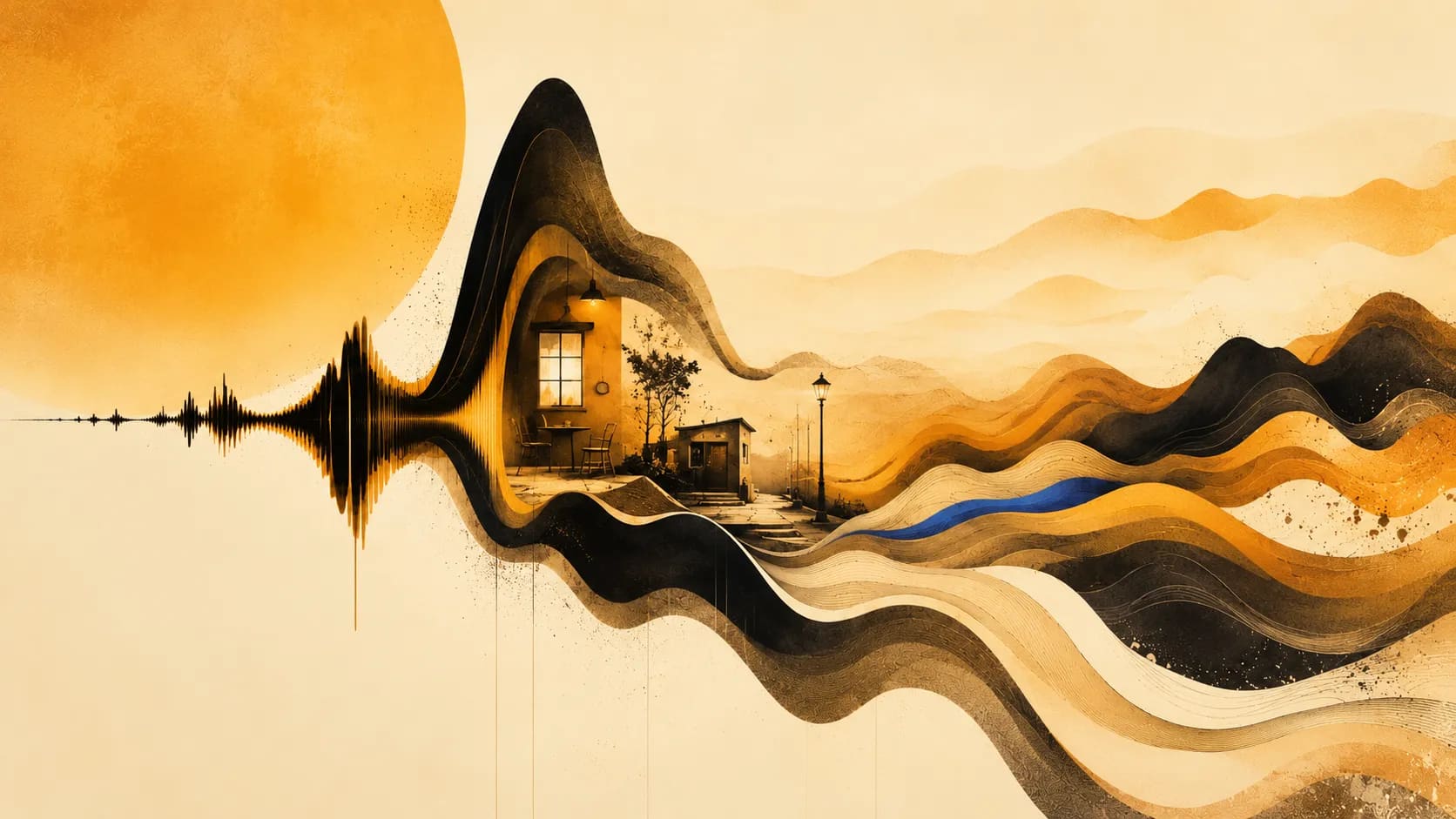
The Half-Second Before The Memory
Fifteen people were asked for a sound that drops them instantly into a specific year, and the room's most striking discovery is how consistently the winning sound was not the main event. It wasn't the song. It was the half-second before the song. Not the movie — the menu music that played while nobody had pressed play yet. Not the whole ringtone — the first fraction of it, already enough.
One signal makes this almost embarrassingly precise: a specific song's opening four notes, explicitly not the whole song, deliver a participant instantly back into "a car I don't own anymore." Another names the exact half-second of vinyl crackle that precedes a track actually starting, insisting twice that it's "not the song, just that half-second," tied to an entire childhood living room. A third finds the same trigger in a DVD menu loop that never even reached the film it was supposedly introducing, attached to a specific sick week home from school. In each case, the participant is oddly insistent that the fragment, not the full piece, is what does the work — as if the completed version would somehow dilute the transportation, and only the unfinished, anticipatory sliver carries the actual charge.
A second wave runs entirely on now-obsolete technology, and functions almost like a shared generational fingerprint. A dial-up modem's connection sequence, tied to a specific closed bedroom door and a fear of the landline being picked up mid-connection. An instant messenger's sign-on chime, credited by its participant with holding "an entire adolescence in one sound." A payphone dial tone, unheard in real life for two decades, that the participant admits they can't explain the persistence of. None of these devices still exist in most participants' daily lives, which may be exactly why the sounds stayed so precisely dated — with nothing newer competing to blur the association, each one got permanently sealed to the exact era it belonged to.
A third wave is physical before it's emotional, the body reacting ahead of any conscious placement. A screen door slamming a certain way, filed as "immediate and physical," tied to grandparents' house. A camera shutter's exact click, returning a participant to twenty-two and an ambition — photography — that the signal implies didn't pan out, though it's mentioned without visible regret. A stadium chant from a season and a team the participant no longer even follows, and yet, in their own words, "still eighteen the second I hear it." These sounds don't require the participant to think about the memory first. The memory arrives as a side effect of the sound, already fully formed, before the participant has consciously started remembering anything.
There's warmth running underneath even the room's more ordinary entries. A box fan's whir, tied to a summer with no air conditioning, remembered — against all logic — fondly rather than miserably, discomfort somehow retroactively softened into nostalgia by enough distance. A specific notification sound tied to "one very specific bad year," offered with far less warmth than the fan, proof that this mechanism cuts both ways: the same instant-transport effect works exactly as well for a relationship the participant would rather not revisit as it does for a beloved grandparent's house.
And then, closing the room, a single dissenting signal: sound has simply never been the sense that does this for its owner, smell does the same work instead. It's a useful reminder that the room's whole premise — that a fragment of sound is uniquely potent — is really a claim about wiring, not about sound itself. For most of this room, the ear got there first. For at least one participant, it was always going to be the nose.
The room wasn't really nostalgic for songs, places, or people. It was nostalgic for a half-second right before something was about to happen — the part most of us never think to miss.


