
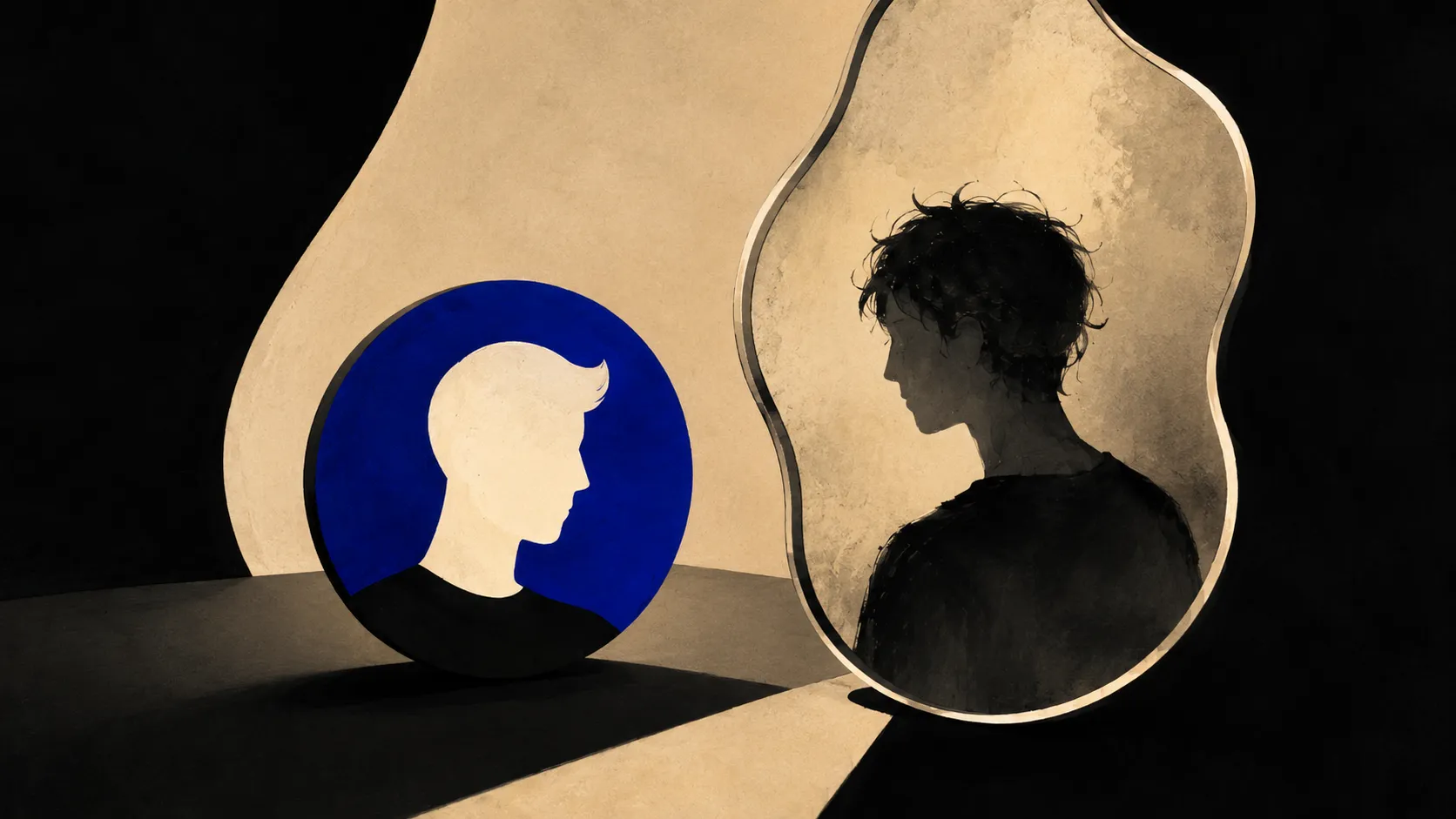
The Filing Cabinet, Not the Mask
The room did not describe a lie. Nineteen Signals arrived, and only two of them come close to admitting to fabrication. The rest describe something more careful: a specific distribution of one self across surfaces, deliberately arranged by an adult who has calculated what each surface is for and what it can carry.
Read the Signals in aggregate and one framing becomes obvious. Almost every participant is describing a set of intentional editorial decisions about self-presentation, and almost none of them experience these decisions as dishonesty. The three-accounts-on-one-platform participant is not confessing to a double life. She is describing a filing system. Twitter me, Instagram me, LinkedIn me are not three fictions of one person. They are three drawers of one filing cabinet, and offline me spends her energy on the drawer labels. That is a much more interesting phenomenon than deception.
Four shapes are doing the interpretive work.
The first is the gap-as-latency. This is the funnier-online participant. It is also the confident-about-culture-online participant who does not want to be watched looking up whether the album is really from 2004. It is the writing-full-stops-online participant. The gap here is not about a different self. It is about the delay online writing permits. Editing time exists offline too, but it is visible; the pause reveals hesitation. Online the pause is silent, and the audience receives only the finished sentence. Several participants are describing themselves as more articulate, funnier, sharper online because the medium hides their drafts. That is not persona. That is being allowed to think.
The second is the gap-as-social-armour. This is the DM-editor participant: "Online we all wear a small proxy that is more able to say the hard sentence." The face-can't-be-seen participant. The braver-online cluster. Here the gap is that the online version of the self does not have to negotiate the muscles of a real room. It does not blush. It does not read the interlocutor's flinch. It can say the sentence the offline self is too polite, too anxious, or too dependent on the physical relationship to say. The room contains a spread of feelings about this armour — some grateful, some ambivalent, one participant clearly worried by what her own comment section reveals about her ("I have watched my own comments and disliked the person writing them").
The third is the gap-as-curation. This is the no-photos-of-child participant. It is the third-account participant. It is the grief-shaped-gap participant: "The pastries are not fake. The grief is what I do not share. Both are true." These Signals share a common structure. There is not a false version and a real version. There is a real version, and there is a deliberately withheld piece of the real version, and the participant is naming that withholding as an editorial decision they have made about which parts of their life the internet gets. The word most of these Signals reach for, and which the room keeps circling, is not dishonesty. It is discretion. And discretion, in the context of a platform that rewards continuous disclosure, has become a small unfashionable act of self-protection.
The fourth is the gap-that-refuses-the-framing. Two Signals stand out. The 19-year-old participant: "The gap language assumes the offline was the original. For my generation the online might be the original." That sentence quietly reframes the whole room. The concept of an "online self" that is different from a "real self" assumes an ordering — offline first, online second, online as derivative. A younger generation is telling us, without ideology, that this ordering may already be wrong for them. The no-account participant is at the opposite end of the same reframe: "People ask if I am on Instagram. I say no. They look at me like they have caught me lying. I am not lying. I have simply refused." Both participants are refusing the room's implicit assumption. One says offline is not the source. The other says online is not obligatory. The room is being pinched from both ends.
Two smaller edges deserve naming.
The inbox-theater Signal is the sharpest small piece of observation in the room. "Being available is now an admission online. I stopped admitting it. I now write emails at midnight so they land at 8am." That describes a whole layer of professional performance that has quietly become universal in certain kinds of work. It is not persona. It is protective coloration. And it is exhausting. That the participant names it as a piece of theater rather than a personality shift is worth noticing. She knows the difference.
The voice-gap Signal is the room's most vulnerable one. "People who meet me after reading me are disappointed. I know because they say so." That is the room's most unromantic version of the gap. Not a curated advantage. Not a filing system. A real cost the writer is paying — an audience developed for the written voice that flinches when confronted with the speaking one. Her closing sentence deserves to end the reveal: she has decided to stop apologizing for the mismatch. The rest of the room has quietly made the same decision. The gap is not a lie. It is where they live now, and they are done explaining it.
The gap is not a lie. It is where nineteen people live now, and they are done explaining it.


