
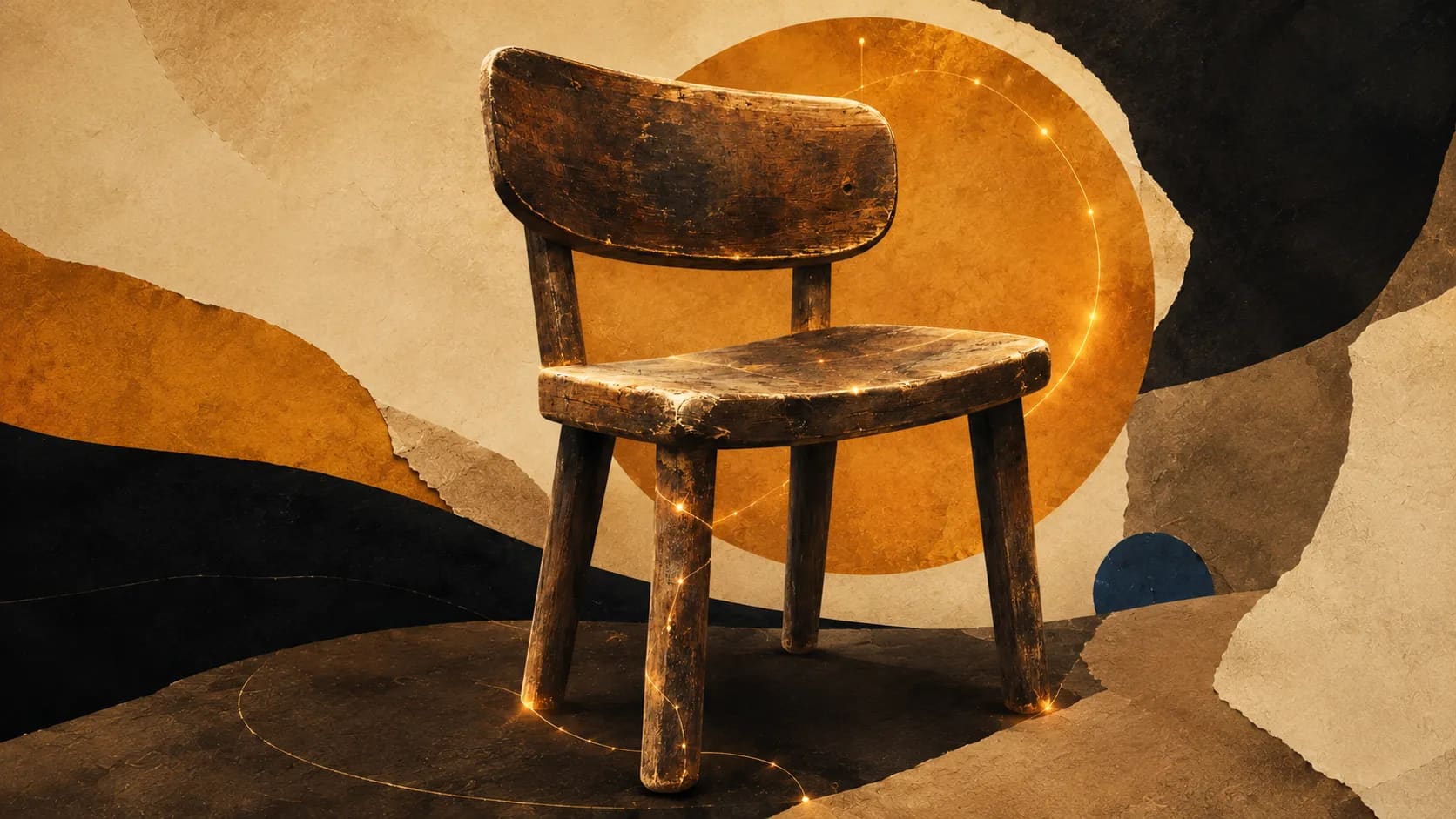
The Wear Was The Point All Along
Ask people to name an object that improves with age and most rooms would produce a list of materials — leather, cast iron, copper, wood, the usual suspects that genuinely do look better worn in. This room produced that list too, but the more interesting thing it produced was a room-wide refusal to fix, sand, polish, or wash away the evidence of use, stated over and over as if it were an active decision rather than a passive one.
The clearest version is almost defiant. A cutting board covered in gouges, kept that way on purpose — "I refuse to sand it down." Copper pots that are "supposed to look tarnished," with polished copper now reading as fake to the participant who owns them. A concrete countertop that stains at the slightest provocation, its owner reframing every mark as documentation of "what we cooked that month" rather than damage to be minimized. In each case, the participant isn't tolerating wear. They're actively defending it against the version of themselves, or a partner, or a cleaning product, that might try to erase it.
A second wave treats the object less as a surface and more as an unintentional diary. Raw denim creasing into the specific shape of where its owner sits and what they carry — described, without hesitation, as "basically a diary entry." A wooden desk with an unfixed coffee ring, kept as "proof of every early morning that mattered." A dog's blanket, shaped permanently by years of the same dog curling into the same spot, its owner stating flatly that the shape will never be washed out, twice, for emphasis. None of these participants are describing an object anymore by the end of their signal. They're describing a record, and the object just happens to be what the record got written on.
A third, quieter register runs through the room: wear left by another person, still visible, still doing work. A leather wallet, a gift from a father, that shifted from stiff and orange to the color of good coffee over a decade of use. A brass doorknob worn shiny in one exact spot, from "decades of the same hand turning it" — a detail that implies a hand that may not still be turning it, though the signal doesn't say so directly. These objects aren't diaries of the participant's own life. They're inherited evidence of someone else's repetition, kept precisely because sanding or polishing it away would erase the last physical trace of that person's routine.
Only one signal in the room breaks from this entirely, and it's worth taking seriously rather than dismissing as an outlier for its own sake. One participant replaces anything the moment it starts to look used, on principle, refusing the whole premise of the room. Read against everything else here, that's not really disagreement about aesthetics. It's a different relationship to time itself — a preference for objects that stay exactly as they arrived, over objects that are allowed to accumulate a life.
What ties the rest of the room together is that nobody described the aging process as something that simply happened to their favorite object. Every single one of them described guarding it — refusing to sand, refusing to wash, refusing to polish, refusing to fix — which suggests the wear was never really an accident these participants learned to accept. It was the entire reason the object earned a place in this room to begin with.
Nobody in this room learned to tolerate their object's wear. They chose it, on purpose, every time they didn't reach for the sandpaper.


