
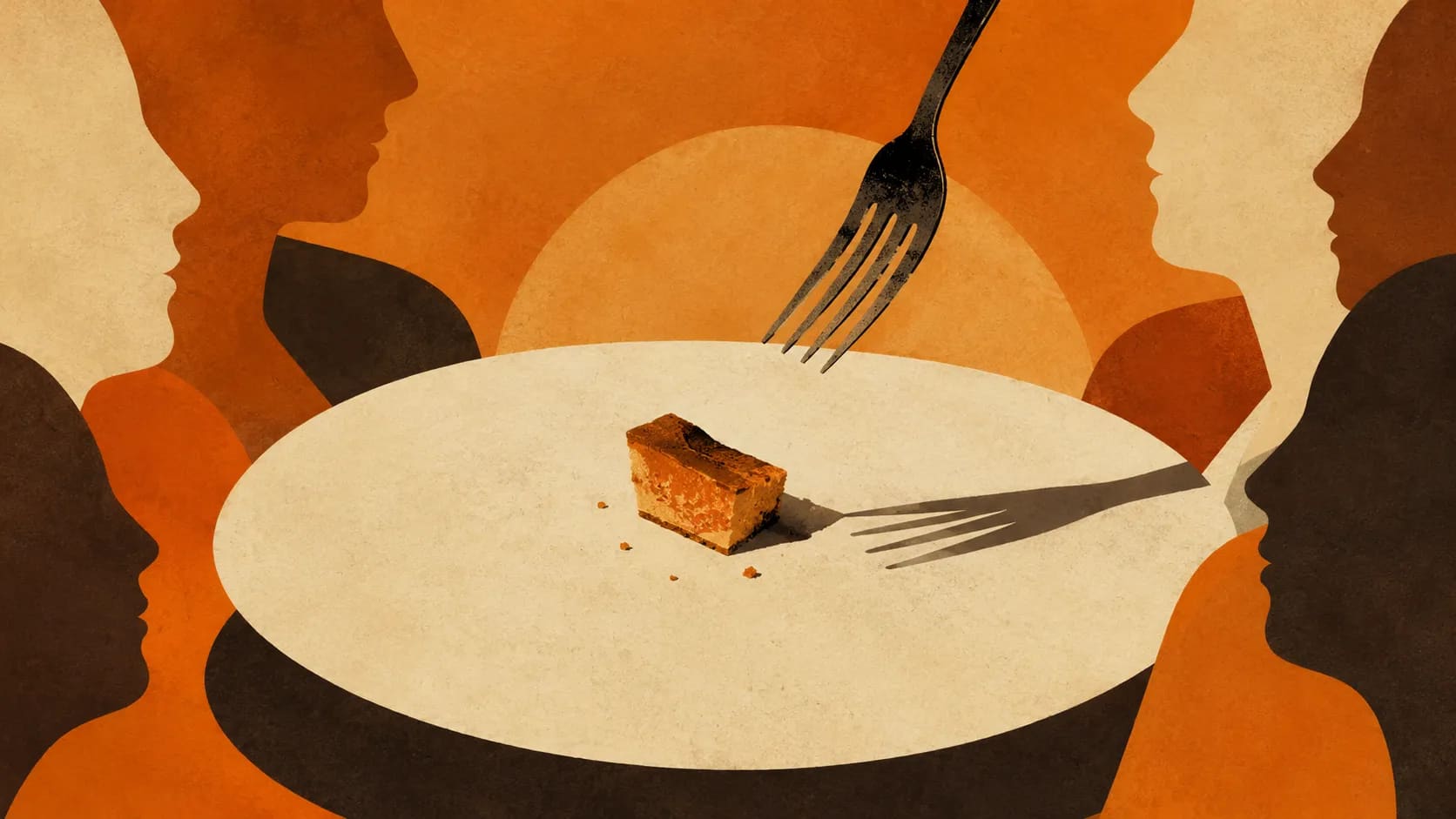
Nobody Actually Wants the Last Bite
Twelve people answered a question about food and produced, almost without exception, a question about labor instead. Who gets the last bite turned out to be a decoy question. The real one, running underneath nearly every signal, was: who is allowed to want something at this table, and who is expected to have already used up their turn.
The clearest version of that came early: “Whoever cooked. Always. It's the unspoken tax on the rest of us.” Framed as an unspoken tax, this wasn't really about a bite of food. It was about a debt structure — the person who did the invisible work of cooking is quietly assigned first claim on the last visible reward, and nobody has to say it out loud because everyone already knows the rate.
That same debt shows up generationally in a sharper form: “My mother. She raised four kids and I have never once seen her finish a meal she cooked.” Four kids, decades of meals, and a mother who — by this account — has never once finished her own cooking. This wasn't offered as a complaint exactly. It reads more like a fact being reported after the fact, the kind of thing you don't notice until you're old enough to count it. The rule here isn't written anywhere. It's just a pattern so consistent it stopped needing enforcement.
Running in parallel to the labor-tax reading was something almost theatrical: the performance of offering. One signal named it directly, more bluntly than anyone else in the room: “There isn't a rule, there's a performance of offering it that nobody is supposed to accept.” This flips the whole question sideways — the last bite isn't actually contested, it's ceremonially declined, over and over, by people who are all privately hoping someone else breaks first. Two other signals in the room described almost the exact same choreography without naming it as performance — one admitting relief every time someone else takes the bite they'd just offered, another describing a guest-gets-it rule enforced even if the guest clearly doesn't want it, which only makes sense if the whole exchange was never really about hunger to begin with.
A third wave broke from the sentimental reading entirely and went procedural instead. One signal proposed silent claiming as the real mechanism: “Whoever notices first and says nothing. Silent claiming is still claiming.” No offering, no ceremony — just whoever notices the bite exists and says nothing, converting attention into ownership before anyone else can object. A blunter version of the same idea showed up elsewhere in the room, where a family reportedly resolved the whole question by speed alone, explicitly rejecting sentiment as the deciding factor. Between these two signals, a genuinely different theory of the table emerges: some families run this on unspoken debt, and some run it on reflexes, and the two groups would probably find each other's households a little baffling.
A few signals resisted the whole premise instead of answering it. One family reportedly defuses the situation entirely by splitting the last bite into pieces too small to count as a real last bite at all: “Nobody. We split it into microscopic pieces like we're diffusing a bomb.” An engineering solution to a social problem, avoiding the question rather than resolving it. Another signal introduced a rule based purely on consumption history rather than status or speed: whoever didn't get seconds earlier gets first claim now, a small internal audit running under the surface of an otherwise casual meal.
Money made one direct appearance and complicated the labor-tax reading considerably. One participant reported that in their family, whoever is paying claims the last bite — a rule apparently strong enough to override actual hunger at the table. This doesn't contradict the cook's-tax theory so much as compete with it: in some households, the currency is effort, and in others, it's literally currency.
By the end, the room hadn't converged on a single rule, but it had converged on a single shape: almost nobody described the last bite as something claimed openly, on the basis of simply wanting it. Every mechanism on offer — debt, performance, speed, payment, silent claiming — was a way of avoiding the plainer and apparently unacceptable answer: I want it and I'm taking it. Twelve people, twelve households, and not one of them admitted to running on desire alone.
It's worth noting what almost nobody in this room did: appeal to fairness in the abstract. No one proposed rotating the privilege, tracking it, or splitting it by some agreed formula. Every system described here was local, specific, and entirely unwritten, which suggests the last bite was never really being managed as a resource at all. It was being managed as a relationship — a small, recurring opportunity to demonstrate who defers to whom, and under what conditions. Even the family that resolved the question through pure speed was, in its own way, encoding a value: reflexes over sentiment, directness over ceremony. Twelve very different households, and twelve very different definitions of what counts as generous. None of them would have called it that. Most of them just called it normal, which is usually the first sign that a rule has been running long enough to stop looking like one.
Everyone has a rule for who deserves it. Nobody has a rule for just saying you want it.


