
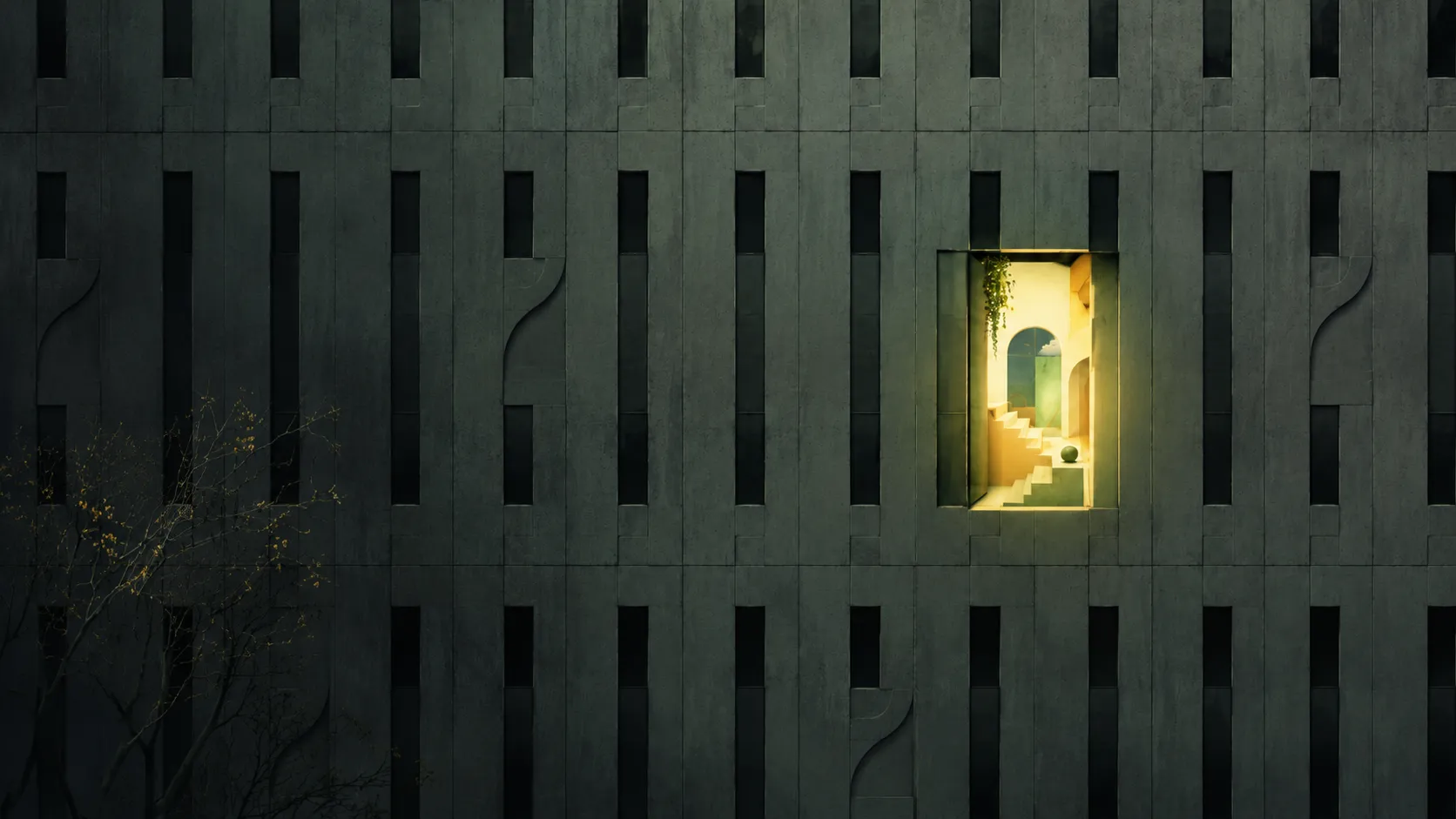
The Function of Not Entering
Thirteen Signals arrived, and almost none of them describe a building the participant intends to enter. The room is not about longing for access. It is about a very specific kind of daily architecture the participant has chosen to keep at a distance — a threshold they are protecting from themselves.
Three shapes are doing most of the work.
The first is the building held as a story that would end if crossed. This is the abandoned printworks: "Something in me needs the printworks to remain unentered." The old cinema with the second-floor light: "If I check I will have one theory. Right now I have all of them." The small blue Victorian on the school route where "someone happy lives there," pointed at by a mother when the participant was eight. In each of these Signals the building is not a mystery to be solved. The mystery is the value. Entering would replace something rich with something specific, and the participant is aware of the trade and is unwilling to make it. That is not indecision. It is a small ongoing act of protective non-consumption.
The second is the building held as a threshold the participant is deliberately not crossing. This is the neighbor's house of twelve years: "the most tender and specific longing I carry. Not for a mystery. For a threshold I am not meant to cross." The synagogue for which asking would make the wanting a problem. The church that is open, whose door is not the obstacle — the participant is the obstacle. These Signals are not describing an inability to enter. They are describing a decision. The building is being loved from a distance not because distance is imposed, but because closeness has been declined. There is a small dignity being kept intact by not knocking.
The third is the building held as archive of a life. The grandmother's house that was sold three years ago: "I am protecting a version of the house that only exists if I never enter it." The gate house at the university the participant did not attend, whose porter's life is imagined in more detail than the participant's own. The modernist library closed in 2019 whose chairs are still being dusted by an unknown someone. In each of these Signals the building is holding a version of a life the participant is emotionally invested in — sometimes their own past life, sometimes a parallel life they did not live. The building is a small physical museum for a possibility. Entering would either confirm the museum's honesty or dissolve it. The participant would rather not force the question.
Two smaller edges deserve naming.
The funeral home Signal is the room's most unadorned confession: "I have wanted to go inside since I was 19. I do not have anyone to bury there. I feel this makes the wanting worse, not better." That Signal is doing something few others do. It admits the wanting has no legitimate cover. Most of the participants have a plausible excuse for their longing — the building is beautiful, or historic, or the participant knows someone nearby. The funeral home participant has no such cover, and is naming that the absence of a cover intensifies the longing rather than dissolving it. Some buildings are wanted precisely because we have no business wanting them.
The pumping station is the room's most technical Signal, and it is also the most modest. "If they ask me why I was there I have no reason. I would like to have a reason someday." That sentence names the room's quiet subject with unusual precision. Many of these participants are describing buildings for which they have not yet earned a reason to be there. They are not owed entry. They are also not owed a reason. Longing has arrived first. The reason has not.
The room's real finding is that the buildings are not withholding themselves. Several of them are open. The participants are the ones maintaining the distance. And they are not doing so out of shyness or lack of curiosity. They are doing so because the buildings are performing a very specific function in their lives — as story, as possibility, as archive, as unearned invitation — and that function is only performed by a building that stays outside the participant. Entering the building would end the function. The participant has decided the function is worth more than the entry. Thirteen small quiet examples of that decision, made every time the participant walks past.
The buildings are not withholding themselves. The participants are. Entering would end what the building is for.


