
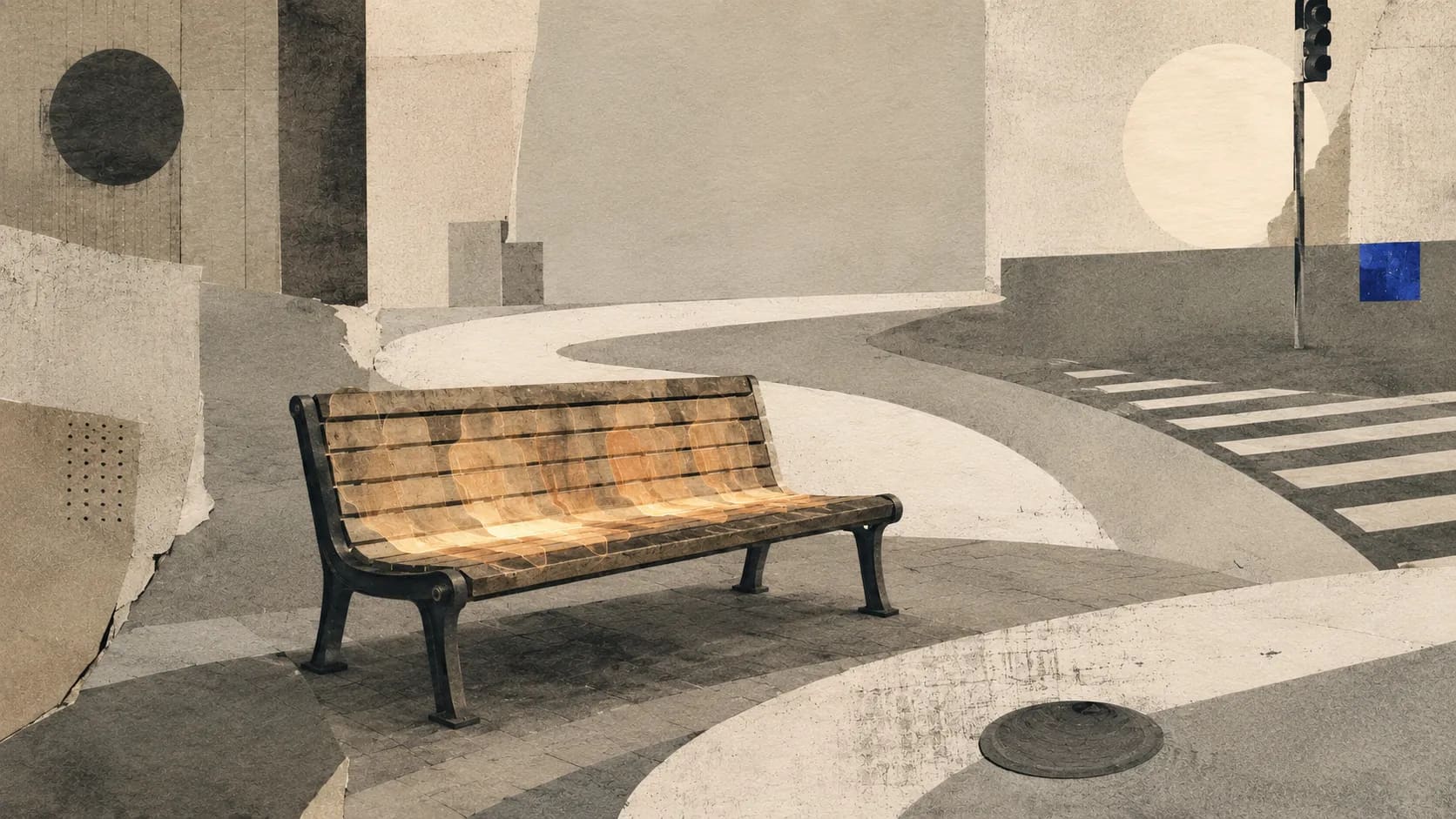
A Bench Doesn't Get to Choose What It Witnesses
A bench is one of the simplest objects a neighborhood can install, and one of the hardest to actually get right, because a bench only works if a body is willing to stop moving on top of it. Fifteen people described a bench nobody uses, and what's striking isn't the emptiness itself, it's how specific and varied the reasons for that emptiness turn out to be. No two benches in this room failed for the same reason.
The most literal cluster is pure design failure: a bench facing a parking lot instead of the park it sits in, a once-great view now staring at a blank wall a new building put up two years ago, splinters visible from ten feet away, a wobble everyone's felt at least once and nobody's reported. These are benches undone by decisions made long before anyone in the neighborhood had a say — a construction crew, a developer, a maintenance schedule that never circled back. The neighborhood didn't reject these benches. The benches were quietly failed before anyone got the chance to use them properly.
A second cluster is entirely about unspoken social contract, and it's the strangest one in the room precisely because nobody had to enforce it. A bench known locally as teenage territory, respected by adults who were never told the rule and somehow all know it anyway. A bench pigeons claimed years ago that nobody has ever tried to reclaim, as if the birds simply won a negotiation no human remembers agreeing to enter. These benches aren't broken or unsafe. They're occupied, in a sense — just not by the people the bench was technically built for.
A third cluster runs on pure discomfort of exposure: a bench behind a dumpster nobody wants to be seen near, another sitting directly on the exact path everyone uses to walk fast through, where stopping to sit feels like blocking a hallway rather than resting. Neither bench is damaged. Both are simply positioned somewhere that turns the act of sitting into something faintly embarrassing, a decision to be visibly still in a spot built for everyone else's motion.
The room's heaviest cluster is small but unmistakable. A memorial bench honoring someone nobody currently in the neighborhood remembers, its plaque now outliving the memory it was meant to preserve. A different memorial bench for someone who died young, avoided not out of neglect but out of a instinct that scrolling a phone there would feel disrespectful. And the room's clearest single image: an old man who sat on one bench every day for years, who simply stopped showing up one day with no explanation offered to anyone, leaving a bench that the whole neighborhood now seems to unconsciously treat as still reserved, still waiting, still his.
What connects all fifteen is that a bench has no say in any of this. It can't fix its own sun exposure, correct its own wobble, or explain why the person who used it every day for years is suddenly gone. It just keeps sitting there, structurally capable of being sat on, absorbing whatever meaning the neighborhood around it decides to assign, whether that meaning is splinters or grief or an unspoken rule about teenagers nobody wrote down anywhere.
Every bench in this room is structurally fine. What they're actually holding has nothing to do with wood or weather.


