
Official reveal
Short Preview Summary
Eighteen people described meetings that failed at their stated purpose while succeeding, quietly, at something else entirely.
Main Signal Waves
[{"read": "Several meetings failed their stated purpose while succeeding completely at a different one — producing the visible appearance of process, inclusion, or planning.", "title": "The Meeting As Performance"}, {"read": "New information and actual decisions consistently arrived outside the meeting itself — in a chat sidebar, in the two minutes after, or in an earlier room the participant wasn't invited to.", "title": "The Real Decision Happens Elsewhere"}, {"read": "A cluster of meetings actively generated the exact overhead problem a meeting is supposed to resolve — scheduling more meetings, needing their own retro, or producing a redundant follow-up email.", "title": "The Recursive Meeting"}]
Full Official Reveal
Ask a room what meeting should have been an email and you'd expect complaints about inefficiency. This room delivered those, but underneath almost every signal was a second, more interesting observation: the meeting wasn't actually failing at its job. It was doing a different job than the one on the invite, and doing it perfectly well.
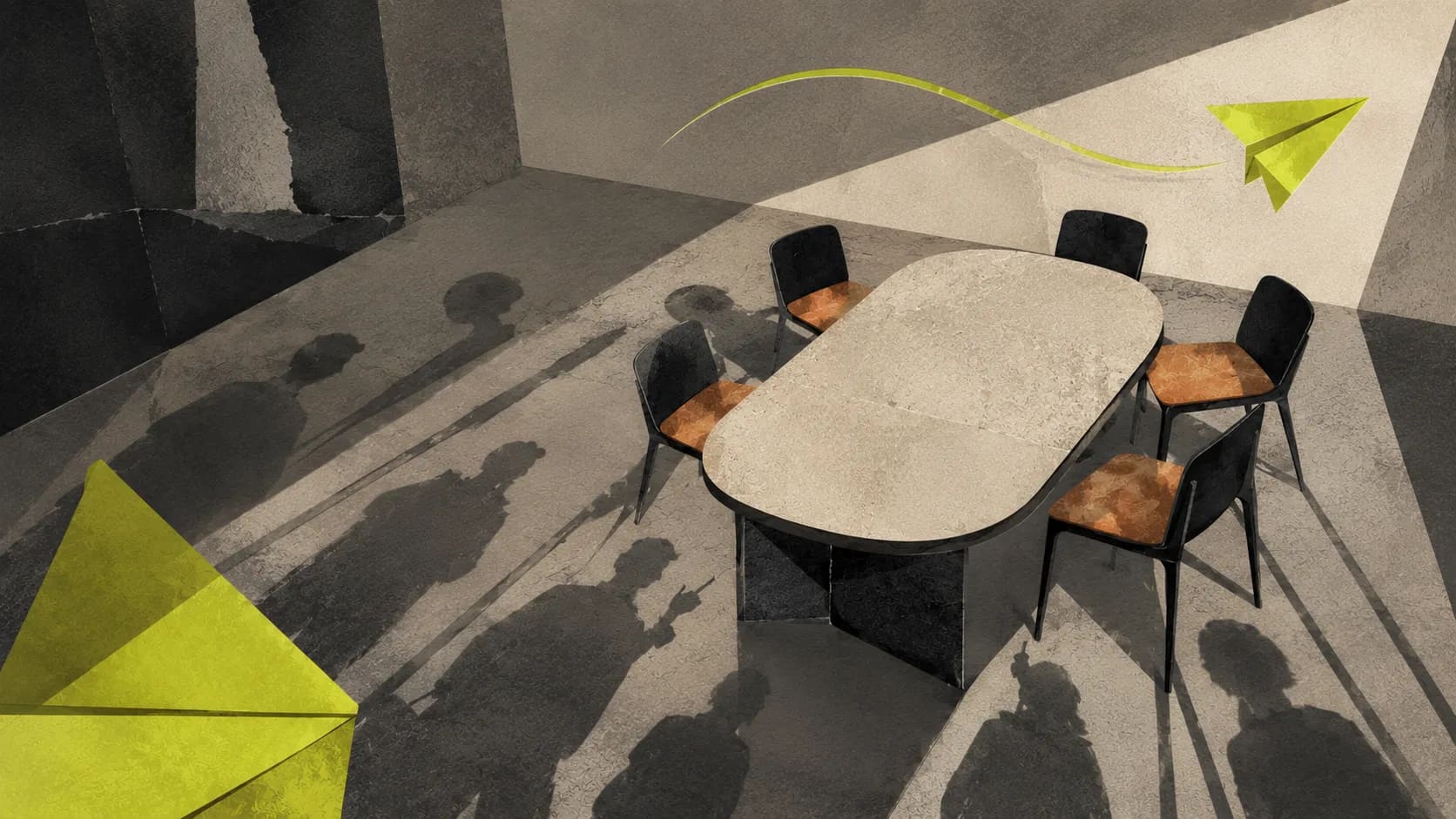
Start with the meetings that exist purely as performance. A brainstorm where the deck was already finished before anyone arrived, making the brainstorming, in the participant's own word, "theatrical." A meeting that existed, according to its own attendee, purely so one person "could say they'd looped everyone in" — nobody needed the looping, everyone already knew, but the loop had to be visibly performed anyway. A weekly meeting whose entire recurring content is someone reading the calendar out loud. None of these meetings failed to happen. They succeeded completely at their real function: producing the appearance of process, inclusion, or planning, regardless of whether any of those things were actually occurring underneath.
A second wave reveals where the real work was actually happening — and it was almost never in the room. One participant describes a decision genuinely getting made "in the two minutes after the official meeting ended," once the recording stopped and people kept talking unofficially. Another describes new information arriving exclusively through a chat sidebar, delivered silently while everyone performed listening to a speaker saying something else. A third was invited as a "stakeholder" for a decision already finalized two meetings earlier, present for a conversation that had already concluded without her. Taken together, these signals draw a map of where organizations actually make decisions: rarely in the meeting itself, more often in the margins around it — the chat window, the two minutes after, the earlier room a given participant wasn't in.
A third wave is almost purely recursive, and it's the room's funniest and bleakest material at once. A meeting convened for the sole purpose of scheduling another meeting, described by its attendee with a flat "I am not exaggerating, that was the entire agenda." A retro meeting whose own process became the exact dysfunction the next retro would need to address, with the participant noting that nobody in the room caught the irony out loud, even as it was happening to them in real time. A meeting that produced a follow-up email summarizing it — an email which, the participant points out with visible exhaustion, could simply have been the original message that made the whole meeting unnecessary in the first place. These meetings didn't just fail to be efficient. They actively generated the exact problem — more meetings, more overhead — that a meeting is supposedly meant to resolve.
A smaller, sharper cluster involves theater around urgency and scale rather than content. Eleven people spending an hour on a font. A meeting booked as urgent that opens by announcing there's no rush on anything discussed. A ten-minute wait for attendees who were never actually coming. In each case, the meeting's framing — urgent, important, requiring a full hour, requiring eleven people — turned out to be entirely disconnected from what the meeting actually needed or delivered, as though scheduling something as a meeting automatically inflated its perceived stakes regardless of the content inside it.
What this room ultimately mapped wasn't inefficiency. It was ritual — a recurring, collectively maintained performance of alignment, inclusion, and diligence that persists specifically because everyone in the room, participant after participant, keeps showing up and playing their part in it, even while writing, later, in a room exactly like this one, that they knew the whole time it should have been an email.