
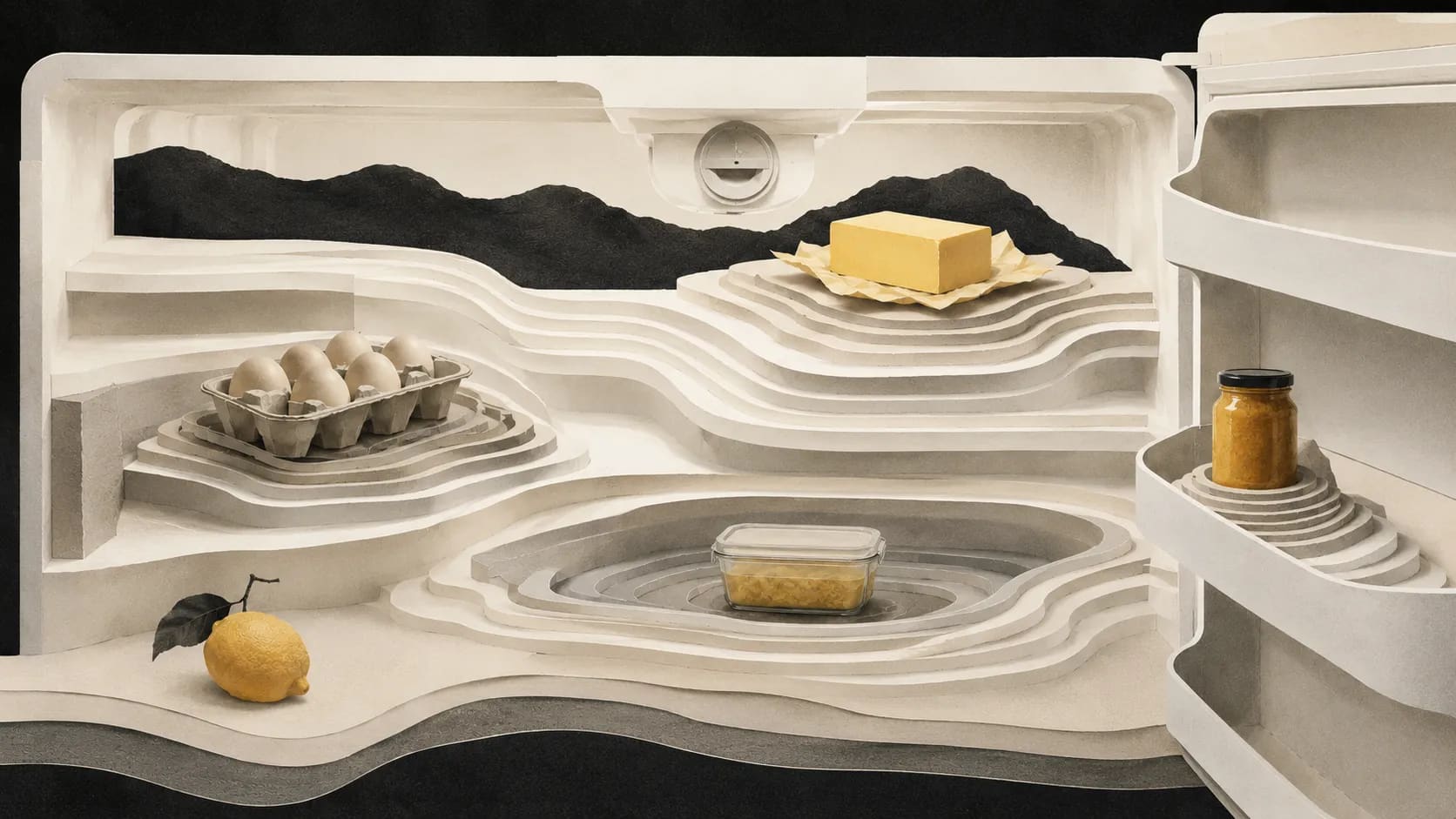
Official reveal
Short Preview Summary
A question about shelves turned out to be a question about guilt, parenting, inheritance, and trust — food was just the medium.
Main Signal Waves
[{"read": "Guilt over expiring food and a polite household fiction about a hiding drawer turned ordinary shelves into sites of quiet, low-stakes moral tension.", "title": "The Fridge As Confession"}, {"read": "At least one participant discovered they'd absorbed a family member's exact organizing logic without ever consciously choosing it — a system caught rather than taught.", "title": "The Fridge As Inheritance"}, {"read": "Where more than one person shares a fridge, the system on display often belonged to whoever happened to be in charge that week, not to any one settled philosophy.", "title": "Order As A Shared-Home Negotiation"}]
Full Official Reveal
A fridge is a small, closed box that almost nobody else ever really sees inside of, which may be exactly why this room's answers came out this honest. Thirteen people were asked about shelf logic and answered, almost without exception, about something else entirely.
The most direct confession sits near the top of the room: a shelf reserved specifically for food nearing its expiration date, which the participant names, unprompted, as "basically a guilt shelf" — an entire section of the fridge dedicated to visible evidence of good intentions running out of time. Nearby, a bottom drawer reserved exclusively for items being hidden from roommates, with the wonderfully deadpan admission that "we all know, nobody says anything" — a whole household maintaining a polite fiction about a drawer everyone has clearly opened. Neither of these participants is describing storage. They're describing an ongoing, low-stakes moral situation that happens to live at refrigerator temperature.
A second wave turns the fridge into something closer to a values statement. A parent keeps one shelf, at a child's exact eye level, stocked with snacks specifically so the child can serve herself without asking — filed by the participant, deliberately, "under parenting, not organizing." Another keeps a middle shelf reserved only for whatever's mid-recipe, a small system built entirely around reducing the mental load of cooking. Neither shelf exists to look good. Both exist to solve a problem that has nothing to do with food storage and everything to do with how the household actually needs to function.
Then there's inheritance, arriving in a single quiet signal that reframes the whole room: a fridge that mirrors a grandmother's exactly, same shelf logic, adopted with no conscious decision ever made — "I just apparently absorbed it." That's the fridge equivalent of an accent you didn't know you had until someone else pointed it out. Nobody taught this participant a system. They caught one, the way you catch a phrase or a posture from someone you spent enough time around, and it only became visible as inherited once it got compared to a whole room of other people's very different systems.
A sharper, more analytical signal names something most of the room was doing without naming it: the door for anything feared to spill, the shelves for anything trusted, "basically a threat assessment." That's not a joke about condiments. It's an admission that even inside a box nobody else looks in, this participant is still running a small, constant risk calculation, sorting the world into what's dangerous and what's safe by instinct.
And running underneath everyone else's carefully described systems is one signal that quietly undercuts the premise of having a system at all: whoever did the week's grocery shopping decides the fridge's entire philosophy, and the household simply switches logics depending on whose turn it was. Paired with the earlier signal about a partner having "a full breakdown" over a fridge with no system whatsoever, it's clear the fridge isn't just personal. In a shared home, it's a small, recurring negotiation between two or more people's very different relationships to order, replayed every time someone puts the groceries away.
What the room adds up to is less a set of preferences and more a set of unexamined beliefs, stored at a consistent thirty-eight degrees: about guilt, about who's allowed to serve themselves, about what's safe and what isn't, and about which parts of a person get passed down without either party ever meaning to pass them.